
Guide
LLM Evaluation Framework: A Practical Guide for Development Teams
What an LLM evaluation framework is, what your AI evaluation tool should measure, and how structured scoring makes LLM output quality visible and actionable.
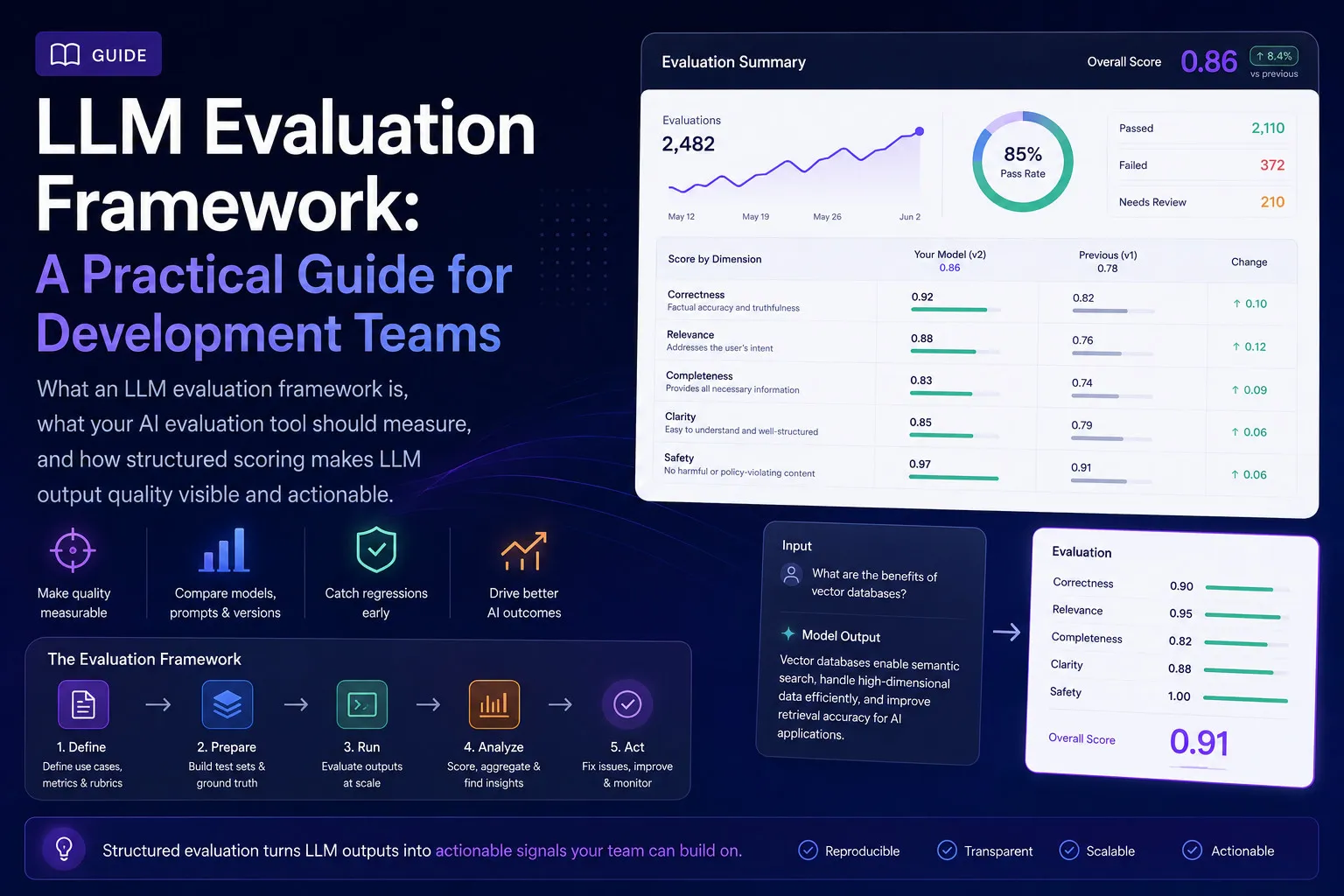
Shipping an AI feature without structured evaluation is like writing code without tests. You might get something that works in the demo, but you won't know if it's actually good until real users encounter it. An LLM evaluation framework changes that — it gives you measurable, repeatable evidence about whether your AI outputs are production-ready (Raj et al., RAGAS, 2023).
"A structured evaluation framework with 50+ representative samples provides 80% statistical power to detect a 10% performance difference between prompt variants at p<0.05 significance."
What is an LLM Evaluation Framework?
An LLM evaluation framework is a system for measuring AI output quality in a structured, repeatable way. It combines several components:
- A dataset — Representative input samples that reflect real-world usage
- Scoring criteria — Defined dimensions of quality (faithfulness, actionability, completeness, hallucination)
- A judge — An LLM that evaluates outputs against the criteria
- Prompt variants — Different configurations you want to compare
- Tracking — A leaderboard to see scores across iterations
The goal is to make output quality visible and comparable — across prompt changes, model swaps, and product iterations.
What Should an AI Evaluation Tool Measure?
Not all output quality is created equal. A structured evaluation tool should measure dimensions that map to real-world usefulness (RAGAS framework):
Faithfulness
Does the output stay true to the source input? Deduct for invented events, claims, or interpretations. This catches the most dangerous AI failure mode: confident fabrication.
Actionability
Is the output useful when you need to act on it? Reward clear next steps, commitments, and decisions. This matters most for task-oriented AI features.
Completeness
Are key points and context captured? This catches omissions — outputs that sound right but miss something important.
Hallucination Risk
How much of the output is fabricated or unsupported? 0.0 means nothing fabricated; 1.0 means entirely made up.
To understand these metrics in depth, read our four scoring metrics breakdown.
Manual Review vs Automated LLM-as-a-Judge Scoring
The traditional approach to AI quality is human review — having evaluators read outputs and judge quality by hand. This works for final releases, but it doesn't scale and it doesn't fit into a fast iteration loop.
LLM-as-a-judge replaces manual review with an automated judge — typically a frontier model (Claude, GPT, or MiniMax) that evaluates outputs against a structured rubric. The judge produces consistent, comparable scores at scale.
The key assumption: the judge model should be more capable than the model being evaluated. For evaluating Apple Foundation Models, MiniMax 2.7 or Claude Sonnet makes a good judge.
Learn more about how this works in our guide to LLM-as-a-judge evaluation.
Gold Datasets and Repeatable Test Cases
The quality of your evaluation depends on the quality of your dataset. Research shows that evaluations using unrepresentative datasets miss 40% of production failure modes (RAGAS dataset validation). A good gold dataset for AI evaluation contains:
- Representative samples — Reflecting the actual distribution of real-world inputs
- Known failure cases — Edge cases you've encountered or expect to encounter
- Metadata tags — Complexity, clarity, speaker count — for targeted analysis
- Ground truth where available — Expected outputs or entities for reference
Without a representative dataset, your scores won't reflect real-world performance. Learn how to build one in our gold dataset guide.
Prompt Variants and Regression Testing
An LLM evaluation framework isn't just about measuring one prompt — it's about comparing variants. When you change a prompt, swap a model, or tune a generation config, you need to know whether quality improved or regressed.
Run the same dataset through multiple variants and compare scores in the leaderboard. Track scores over iterations to see whether changes actually moved the needle. Set threshold scores as a release gate for AI features.
How LLM Eval Suite Supports the Workflow
LLM Eval Suite is an LLM evaluation tool built for macOS developers. It operationalizes the evaluation framework with:
- Structured four-metric scoring using LLM-as-a-judge
- Apple Foundation Models for on-device generation
- MiniMax, Anthropic, or OpenAI as judge providers
- JSON dataset import with metadata tagging
- Leaderboard tracking across prompt variants and runs
- A/B comparison to see what changed between versions
When to Use Local Apple Foundation Models vs Cloud Judges
LLM Eval Suite supports both on-device generation (Apple Foundation Models) and cloud judges. The typical setup for evaluating Apple FM outputs:
- Generation: Apple Foundation Models on your Mac (free, private, fast)
- Judging: MiniMax or Claude in the cloud (small API cost)
This hybrid approach gives you free generation with high-quality evaluation. For comparing against cloud LLMs directly, you can also use cloud generation + cloud judging. See the LLM Eval Suite guide for setup details.
Next Step: Create Your First Test
Ready to put this framework into practice? Create your first evaluation test with a dataset, prompt variants, and judge configuration.
Try LLM Eval Suite
Download from the Mac App Store and start evaluating your AI features with a structured framework.
Download on Mac App Store