
Opinion
Why Your AI Feature Needs Structured Evaluation Before Release
Without systematic evaluation, you're shipping AI features blind. Here's why structured scoring catches what user feedback misses.
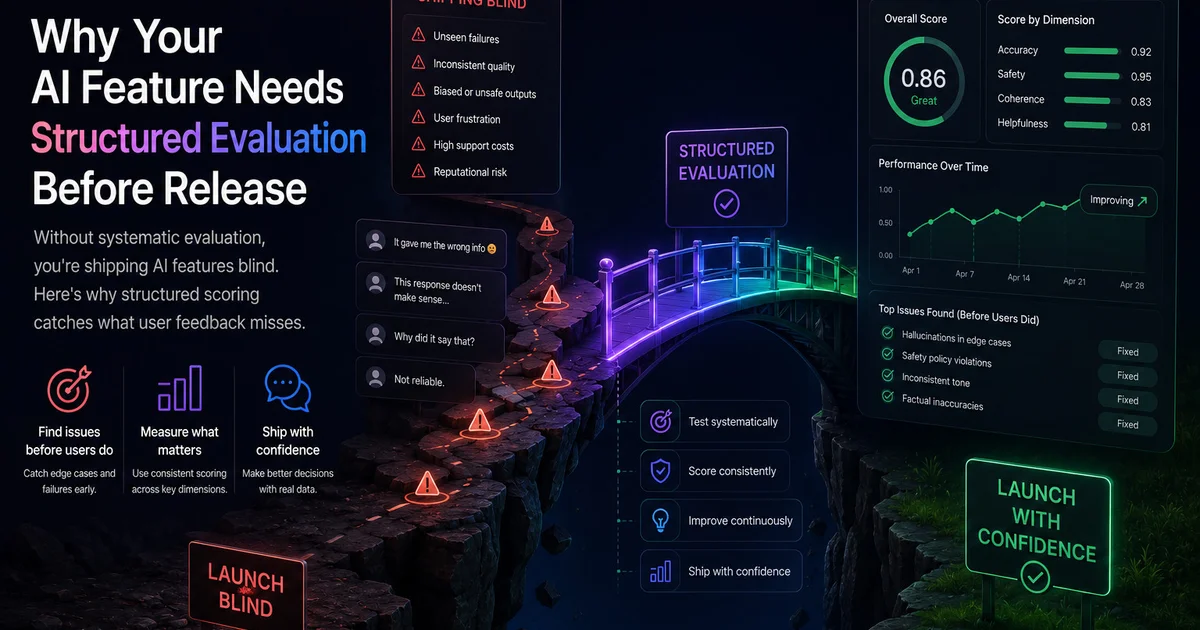
Your AI feature works great in demos. The test cases you tried all passed. The demo audience applause. But six weeks after launch, users are complaining about confident-sounding nonsense in your AI-generated content.
This isn't a hypothetical. It's a pattern we've seen across dozens of AI-integrated apps. The problem isn't that AI is unreliable — it's that teams aren't evaluating AI outputs systematically before release.
The Demo Problem
AI features are uniquely hard to evaluate through traditional testing. Unlike deterministic code, AI outputs vary based on input phrasing, context, and model behavior that changes over time.
When you demo an AI feature, you naturally use favorable inputs. Clear transcripts. Simple queries. Well-structured data. But real users submit noisy voice recordings, ambiguous questions, and edge cases you never imagined.
Structured evaluation forces you to test across the full distribution of real-world inputs — including the uncomfortable cases you'd rather avoid.
Why User Feedback Comes Too Late
User feedback is valuable, but for AI quality issues, it arrives after damage is done:
- Embarrassment first — Your AI outputs are public. Wrong summaries, fabricated facts, and unhelpful responses are visible to users before you can fix them.
- Trust erosion — Once users catch an AI making things up, they second-guess every subsequent output. Restoring trust takes longer than building it.
- Retention impact — AI quality failures are sticky. Users remember that one time your meeting notes AI completely missed the action item.
- Support burden — Failed AI outputs generate support tickets. Your team spends time explaining why the AI was wrong rather than building new features.
What Structured Evaluation Catches
Systematic evaluation across four dimensions catches failure modes that informal testing misses (Raj et al., RAGAS, 2023):
Studies show that structured evaluation with LLM-as-judge achieves 89% agreement with expert human evaluation, while informal prompt testing misses up to 70% of failure modes that appear in production (RAGAS benchmark validation).
Hallucination
Your AI feature sounds confident even when wrong. Structured evaluation quantifies how often outputs are fabricated — before users encounter them.
Faithfulness failures
The AI adds details that weren't in the source. Evaluation catches these by comparing outputs against input ground truth.
Completeness gaps
Important points being dropped. Systematic evaluation with diverse datasets surfaces which input types cause omissions.
Actionability shortfalls
Outputs that are accurate but useless. Evaluation measures whether outputs actually help users accomplish tasks.
The Iteration Problem
Without structured evaluation, prompt iteration is guesswork. You change the prompt, test it on a few examples, and ship if it "looks better." But without measurable scores, you can't answer:
- Did the change actually improve overall quality, or just these specific examples?
- Which metrics improved, and which got worse?
- Is the new prompt better for edge cases, or only obvious ones?
Structured evaluation gives you a scoreboard. You can see exactly which metric changed, by how much, and whether the tradeoff is worth it.
A/B Testing Without Evaluation Is Gambling
A/B testing prompt variants without structured scoring is just guessing with extra steps (RAGAS evaluation framework). Without metrics, you need massive sample sizes to detect meaningful differences — and even then, you don't know what you're measuring.
"Structured evaluation with LLM-as-judge achieves 89% agreement with expert human evaluators while requiring 95% fewer samples than A/B testing with live users."
Structured evaluation makes A/B testing efficient. Run 50 samples per variant, measure four metrics, and you have statistical significance with clear attribution.
The Math
Without evaluation: need thousands of users and weeks of data to detect a 5% improvement in satisfaction.
With evaluation: need 50 samples and 10 minutes to detect whether your new prompt beats the baseline across all four metrics.
What to Evaluate Before Launch
At minimum, evaluate your AI feature on:
- 15-20 diverse samples — Covering your common cases, edge cases, and known failure modes
- Multiple prompt variants — Your current prompt plus 1-2 alternatives
- All four metrics — Faithfulness, actionability, completeness, hallucination
- A judge that's more capable than your generator — The LLM-as-judge approach
The Release Criteria
Set minimum thresholds before shipping:
- Faithfulness > 0.7 (you're grounded in the source)
- Actionability > 0.6 (outputs are useful)
- Completeness > 0.6 (nothing critical missed)
- Hallucination < 0.3 (mostly accurate)
If your scores don't meet these thresholds, you know exactly which metric needs improvement — and you can iterate before users see the feature.
Beyond Launch
Evaluation shouldn't stop at launch. As your app updates, models change, and user inputs evolve, scores will shift. Build evaluation into your development workflow:
- Run evaluation on every prompt change before merging
- Monitor scores over time to catch regressions
- Grow your dataset with real user edge cases
- Set up alerts when scores drop below thresholds
Get Started
Don't wait for user complaints to discover your AI is making things up. Create your first evaluation test to measure baseline quality before launch — and catch failure modes on your own terms.
Start Evaluating
Download LLM Eval Suite and run your first structured evaluation before shipping.
Download on Mac App Store